Krach Institute and Sweden convened allied leaders at the Embassy of Sweden to align strategy for trusted 6G networks—advancing secure connectivity, coordinating policy and standards, and strengthening freedom through trusted technology.
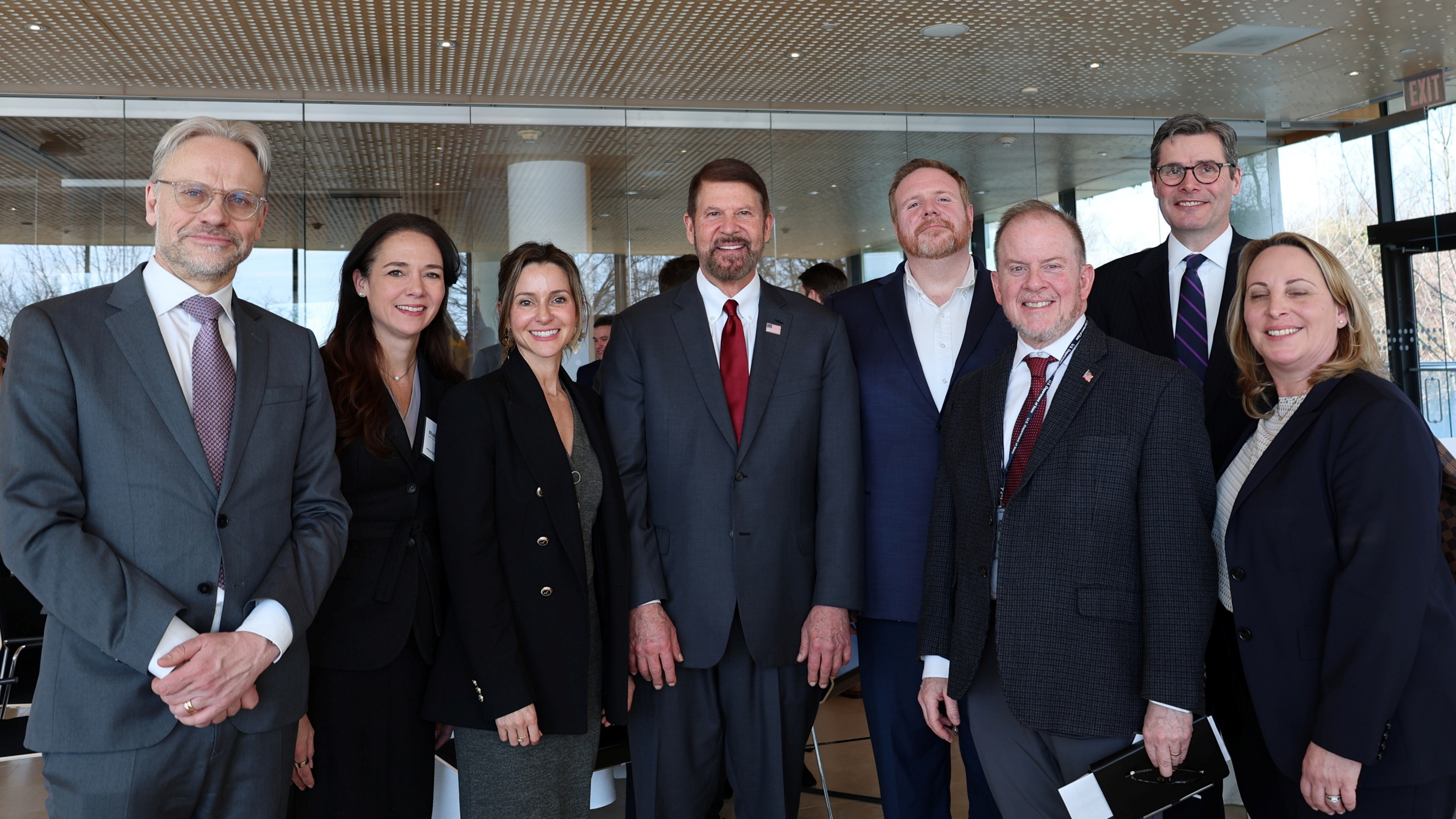
WASHINGTON, D.C. — March 9, 2026 — The Krach Institute for Tech Diplomacy at Purdue and the Embassy of Sweden hosted senior government, industry, and diplomatic leaders at the Embassy of Sweden for “Allied Pathways for Trusted Connectivity,” a high-level roundtable focused on developing a unified strategy for the emerging 6G ecosystem. Grounded in a shared commitment to trusted technology, the gathering marked a critical step in coordinating allied execution of the 2026 White House Memorandum, “Winning the 6G Race.”
As governments and companies worldwide race to develop next-generation networks, participants emphasized that 6G cannot just be faster; it must be trusted, secure, and designed to advance freedom. Building on the global success of the Clean Network model, spearheaded by Keith Krach during his tenure as Under Secretary of State for Economic Growth, participants examined how to extend these trusted connectivity principles to 6G.
The historic Clean Network initiative mobilized more than 60 countries and 200 telecommunications companies and carriers worldwide to exclude untrusted vendors from critical 5G infrastructure, safeguarding data, protecting sensitive networks, and defending democratic values. Participants discussed how these foundational lessons from Clean Network – trust, transparency, security-by-design, and democratic governance – must now guide the deployment of emerging technologies to ensure 6G advances freedom and strengthens U.S. and allied security.
Keith Krach, Chairman of the Krach Institute for Tech Diplomacy at Purdue emphasized the need for alignment on these critical technologies, saying: “Our competitive strength is in numbers and unity. We need to get aligned, and it starts with the United States and Sweden.”
Bridging Policy, Technology, and Freedom
The program featured a keynote by Adam Cassady, Principal Deputy Assistant Secretary of the National Telecommunications and Information Administration, who outlined U.S. policy priorities for transatlantic 6G deployment, spectrum planning, and allied coordination. Cassady emphasized that trusted technology leadership is as much about values as it is about speed, and that early alignment among allies was critical to securing global standards that protect both commerce and democracy.
A fireside chat featuring Krach, Erik Ekudden, CTO of Ericsson, and Ambassador Carl Magnus Eriksson, Sweden’s Special Envoy for International Cyber and Digital Affairs, explored the technical and security challenges of transitioning from 5G to 6G. The speakers highlighted the need for proactive security, early standardization, and cross-border collaboration, to ensure the 6G ecosystem is resilient, reliable, and grounded in the principles of freedom and trust globally.
Building Secure, Trusted 6G Networks Together
The event concluded with a roundtable discussion featuring senior officials from the U.S. Department of Commerce, U.S. State Department, Intel, Qualcomm, the Aerospace Industries Association, Boeing, Saab, Ericsson, and Deloitte. The dialogue focused on three core imperatives:
Coordinated and Market-Driven Governance: Industry and legislative partners must align around a market-driven framework for spectrum and data governance that accelerates innovation and expands connectivity – without constraining productivity. Smart coordination should multiply economic gains while embedding trust and transparency at the foundation.
Policy & Standards Alignment: The United States and its allies must harmonize spectrum policy to prevent fragmentation and protect interoperability. Early coordination on global standards is essential to ensure networks and devices connect seamlessly – and that trusted technology, not untrusted systems, shapes the global ecosystem.
Transformational Security: As spectrum underpins aerospace, defense, and space technologies, innovation must move in lockstep with protection. 6G cannot be merely a technological upgrade – it must be a security upgrade. Embedding resilience and security-by-design from the outset will ensure next-generation networks strengthen national security while advancing freedom.
The dialogue made clear that leadership in 6G was not only about winning a technological race. It is about deciding who shapes the rules and ensuring that emerging and critical technologies reinforce democratic values, protect citizens, and advance freedom worldwide.
For more information or to schedule an interview, please contact Megan Stencel at megan@javelindc.com or 703-490-8845.
About the Krach Institute for Tech Diplomacy at Purdue
The Krach Institute is the world’s preeminent trusted technology accelerator. As the leader in the new category of Tech Diplomacy, the Institute integrates technology expertise, Silicon Valley strategies and foreign policy tools to build the Global Trusted Tech Network of governments, companies, organizations and individuals to accelerate the innovation and adoption of trusted technology and ensure technology advances freedom.
Visit TechDiplomacy.org and follow on LinkedIn, X, Facebook, and YouTube. Subscribe to Tech Diplomacy Now for the latest news at the intersection of high tech and foreign policy.
###
JOIN THE MOVEMENT